Russia holds State Duma election, including in occupied Ukrainian territories
Russia held elections for all 450 State Duma seats from September 18 to 20, alongside regional and local contests. United Russia won 355 seats, while voting in Ukrainian territories occupied by Russia became a focus of dispute over the vote’s legality and whether participation reflected residents’ free choice.
Summary written by our automated pipeline from the outlets' reporting. How it works
14 outlets in 9 countries, 2 relaying others' reporting · earliest dated report in our sources by CNews (France),
“…это как дополнительный элемент прозрачности избирательного процесса, помогает нам снизить и уровень недоверия к избирательному процессу”
Machine translation: “…this is an additional element of transparency in the electoral process; it helps us reduce the level of distrust in the electoral process as well”
More from Russia (7)
Rodion Miroshnik, Russian Foreign Ministry official
Residents of the Donetsk and Luhansk People's Republics and the Zaporizhzhia and Kherson regions participated actively in the further development of the state and its political system by voting in the elections.
“Это говорит о том, что жители уже давно считают себя частью большой России и связывают с ней свое будущее, развитие для себя и детей.”
Machine translation: “This shows that residents have long considered themselves part of big Russia and connect their future and development for themselves and their children with it.”
Igor Kastyukevich, Russian senator from Kherson Oblast
Kastyukevich said elections in the historical regions had very high turnout despite what he described as intimidation and provocations by Ukraine's armed forces.
“Выборы в исторических регионах прошли с крайне высокой явкой, несмотря на постоянные запугивания и провокации со стороны ВСУ.”
Machine translation: “Elections in the historical regions took place with extremely high turnout, despite constant intimidation and provocations by the Ukrainian Armed Forces.”
Regional and local government
Sergei Sobyanin, Mayor of Moscow
“This unprecedented attack was clearly planned with the aim of disrupting the elections.”
“They are crucial for him because they demonstrate that the majority supports the main party, the party of war, and that he has legitimacy for further escalation and the…”
ATESH alleged that commanders of Russia's 291st Motor Rifle Regiment used identities of soldiers killed in Ukraine to cast ballots for United Russia in occupied Zaporizhzhia Oblast after the unit missed a voting target.
Points where outlets or parties give conflicting facts or readings. Each side is summarised by our pipeline; its sources are listed under it.
Disputed Whether the election represented free political choice
Putin said strong participation showed public support for the authorities.
Sources (1)
“Such strong public involvement – with a record number of people coming to polling stations to vote – shows that the people of Russia support our efforts aimed at strengthening the…”
Vladimir Putin, Russia's president · quoted in TASS
Critics said opposition was restricted and alleged coercion or manipulation, including in occupied territories.
Russian officials described residents as voting in their historical homeland and treated participation as part of integrating the territories into Russia.
Sources (2)
Denis Pushilin, Head of Russian occupation administration · our summary of The Kyiv Independent
Maria Zakharova, Russian Foreign Ministry spokesperson · our summary of RIA Novosti
Other voices
Reactions from other countries and bodies, others involved, and commentary.
China
Wang Yi, China's foreign minister
Wang said the election results fully demonstrated the common will of the Russian people.
Pere Joan Pons, OSCE Parliamentary Assembly official
“Russia’s refusal to invite an election observation mission seriously breaches its international commitments and shows a worrying disregard for democratic standards.”
The European Union said Russia's elections in occupied Ukrainian territory violated international law and that it would recognize neither the vote nor its results.
“Russians are ready to support, symbolically, Putin, the Kremlin and the war, but if they have to pay a personal price, or even [an] economic price, they are unwilling to do that.”
Jaroslava Barbieri, Chatham House Ukraine Forum researcher
“Ostensibly framed as a security measure against Ukrainian partisan strikes, this is about direct intimidation, and it is a flagrant violation of international law”
Ivana Stradner, Foundation for Defense of Democracies analyst
“The State Duma elections give the Kremlin a chance to manufacture the appearance of public support… not only for United Russia, but for continuing Putin’s aggression in Ukraine.”
Each outlet's headline, linked to its article. Non-English headlines are machine-translated. The groupings and notes on what each outlet emphasises are automated.
Voting in Ukrainian territories occupied by Russia was presented by Russian officials as political integration, while Ukraine and the European Union rejected it as illegal.
Maria Zakharova, Russian Foreign Ministry spokesperson · our summary of RIA Novosti
Critics questioned whether the election offered genuine competition and free choice, citing the exclusion of anti-war opposition and allegations of coercion and manipulation.
French coverage: CNews focused on the limited field of permitted competitors, the exclusion of Yabloko, early vote figures, and the absence of OSCE observers.
Russian state media: TASS and RIA Novosti emphasized official turnout, the election timetable and results, and Russian officials’ account of participation in the newly claimed territories.
Ukrainian coverage: The Kyiv Independent and Ukrainska Pravda emphasized the vote’s rejection by Ukraine, its use to legitimize control of occupied territories, and allegations of coercion or manipulation.
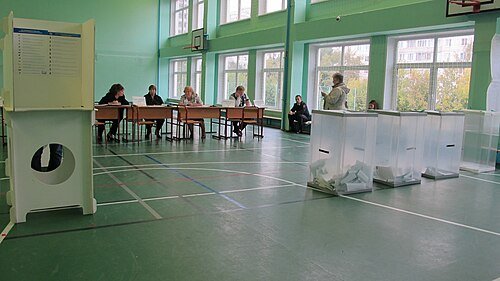
A polling station during Russia’s State Duma election, September 18, 2016. The photo shows polling tables and ballot boxes at precinct election commission No. 768.