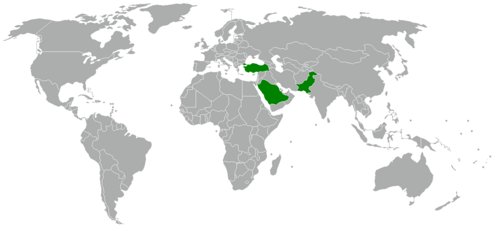
Saudi Arabia, Türkiye and Pakistan put collective-defense pact into practice
At an October 5 emergency meeting in Riyadh, Saudi Arabia, Türkiye and Pakistan agreed to put the Mecca pact's collective-defense commitments into practice immediately and arrange rapid deployment of agreed forces and capabilities in Saudi Arabia; their statement gave no troop numbers or roles. Türkiye submitted the pact for parliamentary ratification on October 20, while Egypt's Sisi offered bounded defensive support for Saudi Arabia and parliamentary authorization remained pending, with debate scheduled to resume October 26.
Summary written by our automated pipeline from the outlets' reporting. How it works
28 outlets in 18 countries, 6 relaying others' reporting · earliest dated report in our sources by RIA Novosti (Russia),
Ishaq Dar said the agreement does not replace existing agreements and is open to countries that uphold its principles and resolve differences peacefully.
Faisal bin Farhan said the agreement does not indicate an intention to build a military axis or sectarian bloc and is not linked to nuclear pursuits or an arms race.
“لا تمثّل أي توجّه لبناء محور عسكري أو تكتلّ طائفي-مذهبي، وليست مرتبطة بمساعٍ نووية أو سباق تسليح،”
Machine translation: “…do not represent any tendency toward building a military axis or a sectarian-confessional bloc, and are not linked to nuclear efforts or an arms race,”
More from Saudi Arabia (1)
Prince Faisal bin Farhan, Saudi foreign minister
Faisal bin Farhan said the agreement is not a threat to the security of any country in the region.
“Mekke Ortak Savunma Anlaşması'nı İran'a, İsrail'e veya herhangi bir üçüncü ülkeye karşı kurulmuş bir ittifak olarak değerlendirmek doğru olmaz.”
Machine translation: “It would not be right to regard the Mecca Joint Defense Agreement as an alliance established against Iran, Israel, or any third country.”
More from Türkiye (2)
Turkish officials
Officials said the pact is defensive and that Turkish troops would not be sent to fight in Yemen or attack the Houthis.
The strategic partnership among the countries aims to strengthen collective deterrence, increase joint defense capabilities, and maintain security and stability in the region.
“…bu stratejik ortaklık, kolektif caydırıcılığın güçlendirilmesini, savunma alanındaki ortak kabiliyetlerin artırılmasını ve bölgemizde güvenlik ve istikrarın korunmasını…”
Machine translation: “This strategic partnership aims to strengthen collective deterrence, increase joint capabilities in the field of defense, and preserve security and stability in our region.”
Where accounts differ
Points where outlets or parties give conflicting facts or readings. Each side is summarised by our pipeline; its sources are listed under it.
Disputed Whether the pact could be implemented before Turkish parliamentary approval
The joint statement said Türkiye and Pakistan would put the collective-defense commitments into practice immediately.
Sources (1)
joint statement, Saudi, Pakistani and Turkish governments · our summary of Deutsche Welle
Turkish lawmaker Namik Tan questioned how the pact could be valid and implemented without parliamentary approval.
Sources (1)
“How can the so-called Mecca agreement on joint defense be valid and implemented without having been submitted to the Turkish parliament for approval?”
Namik Tan, Yeni Parti politician · quoted in Deutsche Welle
Other voices
Reactions from other countries and bodies, others involved, and commentary.
Iran
Hossein Mohebi, IRGC spokesperson
The Mecca Agreement is a clear example of regional countries realizing that US bases are of no good for them.
“If at some stage the leadership of the Islamic Republic of Iran decides that contacts with this structure could help advance the cause of peace and free development, we will…”
Turkish and Pakistani officials said the pact is not directed against Iran or another country, but have not stated how they would respond to an Iranian attack.
The Mecca agreement's first article says the parties shall use all necessary means to eliminate threats to one another's territorial integrity, sovereignty or internationally recognised borders.
Bruno Huberman said the new bloc is not anti-Iran, does not seek to subjugate Iran and does not consider the Axis of Resistance the region's main threat.
As quoted in Portuguese, with a machine translation
“Importante colocar que esse novo bloco ele não é anti-Irã. Não busca subjugar a República Islâmica do Irã e não têm no Eixo da Resistência [grupo de atores contrários à política…”
No translation yet.
Baris Doster, Marmara University academic
Doster said the agreement was more likely to be symbolic than operational unless the parties faced a common threat.
At an emergency meeting in Riyadh on October 5, 2026, the three countries agreed to implement their collective-defense commitments immediately and arrange rapid deployment of agreed forces and capabilities in Saudi Arabia.
The decision was announced after an emergency meeting of the alliance committee in Riyadh to address security threats facing Saudi Arabia.
joint statement, Saudi, Pakistani and Turkish governments · our summary of Xinhua
Pakistan, Saudi Arabia and Turkey agreed to implement their collective-defence commitments immediately and ensure rapid deployment of agreed forces and capabilities in Saudi Arabia.
joint statement shared by Pakistan’s foreign ministry · our summary of The Hindu
The statement said the decision was made at an emergency meeting in Riyadh and would be carried out under approved arrangements and the three countries’ national laws.
joint statement shared by Pakistan’s foreign ministry · our summary of The Hindu
2026-10-20
On October 20, Türkiye submitted the Mecca agreement to parliament for ratification.
The 16-article Mecca Agreement among Türkiye, Pakistan and Saudi Arabia was submitted to the Grand National Assembly's Speaker's office the day before publication.
On October 21, Sisi said the proposed support would defend Saudi territory and borders, would not include an attack on Yemen, and could extend to another Arab state's territory if requested, within the stated geographic limits.
Egypt's military support for Saudi Arabia will be limited to defending Saudi territory and borders and will not include attacks on Yemen.
Abdel Fattah el-Sisi, Egypt's president · our summary of Yonhap News AgencyAs quoted in Korean, with a machine translation
“사우디에 대한 이집트의 군사 지원은 사우디의 영토와 국경을 방어하는 데 국한될 것이며 예멘에 대한 공격은 포함되지 않는다”
Machine translation: “Egypt's military support for Saudi Arabia will be limited to defending Saudi territory and borders and will not include attacks on Yemen”
Egypt would defend the territory of other Arab countries if requested.
Abdel Fattah el-Sisi, Egypt's president · our summary of Yonhap News Agency
Egypt's military efforts will not go beyond its own territory or the territory of neighboring Arab countries whose security and stability Egypt seeks to protect.
Abdel Fattah el-Sisi, Egypt's president · our summary of Yonhap News AgencyAs quoted in Korean, with a machine translation
“이집트의 군사적 노력은 자국 영토나 이집트가 안보와 안정을 지키고자 하는 주변 아랍 국가의 영토를 벗어나지는 않을 것”
Machine translation: “Egypt's military efforts will not extend beyond its own territory or the territory of neighboring Arab countries whose security and stability Egypt seeks to protect”
2026-10-21
During an October 21 meeting in Riyadh, Egyptian Foreign Minister Badr Abdelatty and intelligence chief Hassan Rashad met Crown Prince Mohammed bin Salman; the Saudi account said the Crown Prince received Sisi's written message addressed to King Salman.
Egypt's foreign minister and intelligence chief delivered a written message from Egypt's president to King Salman.
Royal Court of Saudi Arabia · our summary of RIA Novosti, via Saudi Press AgencyAs quoted in Russian, with a machine translation
“…передали письменное послание президента республики королю Салману бен Абдель Азизу”
Machine translation: “[They] delivered a written message from the republic's president to King Salman bin Abdulaziz”
Coverage
Each outlet's headline, linked to its article. Non-English headlines are machine-translated. The groupings and notes on what each outlet emphasises are automated.
None of our outlets is based in Egypt, Greece or Yemen. Our outlets in Iran didn't cover it. No statements from the government or officials of Yemen or United States are in our sources.
Written by our automated pipeline from the statements in the coverage; each point lists the statements it rests on.
Key points
The pact treats an external armed attack on one signatory as an attack on all three; support would depend on a needs assessment and the parties' available capabilities. The joint statement gave no force numbers or roles, and analyst Burcu Ozcelik said the capabilities and mission scope had not been made public.
“However, what the activation of the Mecca pact means operationally, including the specific capabilities deployed and the scope of their missions, has not been made public”
Burcu Ozcelik, Security analyst · quoted in Deutsche Welle
The three countries agreed to implement their collective-defense commitments immediately and arrange rapid deployment under approved arrangements and national laws. Türkiye submitted the pact to parliament for ratification; Turkish officials described it as defensive, while Tan questioned its validity and implementation without parliamentary approval.
Sources (4)
joint statement shared by Pakistan’s foreign ministry · our summary of The Hindu
joint statement shared by Pakistan’s foreign ministry · our summary of The Hindu
joint statement, Saudi, Pakistani and Turkish governments · our summary of Deutsche Welle
Sisi said Egypt would defend Saudi territory if asked, subject to parliamentary approval, and would not attack Yemen. He also said Egypt could defend another Arab state if requested and would keep its military efforts within Egypt or the Arab territory it sought to protect; debate on authorizing support was scheduled to resume October 26.
Sources (3)
Abdel Fattah el-Sisi, Egypt's president · our summary of Yonhap News Agency
As quoted in Korean, with a machine translation
“사우디에 대한 이집트의 군사 지원은 사우디의 영토와 국경을 방어하는 데 국한될 것이며 예멘에 대한 공격은 포함되지 않는다”
Machine translation: “Egypt's military support for Saudi Arabia will be limited to defending Saudi territory and borders and will not include attacks on Yemen”
Abdel Fattah el-Sisi, Egypt's president · our summary of Yonhap News Agency
Abdel Fattah el-Sisi, Egypt's president · our summary of Yonhap News Agency
As quoted in Korean, with a machine translation
“이집트의 군사적 노력은 자국 영토나 이집트가 안보와 안정을 지키고자 하는 주변 아랍 국가의 영토를 벗어나지는 않을 것”
Machine translation: “Egypt's military efforts will not extend beyond its own territory or the territory of neighboring Arab countries whose security and stability Egypt seeks to protect”
Saudi reporting distinguishes King Salman as the addressee of Sisi's message from Crown Prince Mohammed bin Salman, who received it in Riyadh. The Saudi account said the message focused on bilateral ties and affirmed Egypt's solidarity with and support for the kingdom.
Royal Court of Saudi Arabia · our summary of RIA Novosti, via Saudi Press Agency
As quoted in Russian, with a machine translation
“…передали письменное послание президента республики королю Салману бен Абдель Азизу”
Machine translation: “[They] delivered a written message from the republic's president to King Salman bin Abdulaziz”
Royal Court of Saudi Arabia · our summary of RIA Novosti, via Saudi Press Agency
Royal Court of Saudi Arabia · our summary of RIA Novosti, via Saudi Press Agency
How coverage differed
The pact's terms and implementation: Reports cover the collective-defense provision, the Riyadh meeting and arrangements for rapid deployment, while noting that force details and mission scope were not made public.
Ratification and signatory positions: Reports describe Türkiye's parliamentary submission, defensive assurances, possible support options and Pakistani responses to troop-deployment reports.
Egypt's proposed support and parliamentary process: Reports cover Sisi's conditional offer, stated limits on possible support, the postponed vote and reactions to potential Egyptian involvement.
Egypt-Saudi diplomacy and Sisi's message: Reports describe the Riyadh meeting, the message's addressee and recipient, and accounts of its contents.