Israel election leaves blocs short of a majority amid coalition and funding disputes
Israel’s final seat count gave Netanyahu’s bloc 53 seats, Eisenkot’s bloc 48 and Arab-led parties 19, leaving no bloc with the 61 seats needed for a majority. Coalition talks are complicated by disagreement over Arab-party support, while allegations of fraud and foreign funding prompted an investigation that Qatar denied; police and election officials said they had no evidence of broad electoral fraud.
Summary written by our automated pipeline from the outlets' reporting. How it works
39 outlets in 25 countries, 6 relaying others' reporting
Points where outlets or parties give conflicting facts or readings. Each side is summarised by our pipeline; its sources are listed under it.
Accounts conflict Whether Netanyahu and army chief Eyal Zamir clashed over Iran-related military action
Channel 12 reported a clash over an instruction for action that defense officials feared could lead to confrontation with Iran, and said Zamir resisted carrying it out.
“외국 세력이 크네세트(이스라엘 의회)를 장악하고, 이스라엘을 이슬람화하며, 우파 통치를 전복하려 시도하고 있다”
Machine translation: “Foreign forces are taking control of the Knesset (Israeli parliament), Islamizing Israel, and attempting to overthrow right-wing rule”
Benjamin Netanyahu, Israel's prime minister · our summary of BBC News
Eisenkot accused Netanyahu and Likud of a coordinated campaign to delegitimize the results; the Joint List said Netanyahu himself was trying to steal the election.
Sources (2)
“It's already clear that Likud and Netanyahu have embarked on a coordinated, organised campaign seeking to delegitimise the results of the election”
Gadi Eisenkot, Israeli opposition leader · quoted in France 24, via AFP
“Netanyahu is working to steal the election”
Joint List, Israeli political alliance · quoted in PBS NewsHour, via Associated Press
Accounts conflict Whether Netanyahu courted Mansour Abbas during government-formation talks after the 2021 election
The Times of Israel said Netanyahu was widely reported to have courted Abbas, and Abbas maintained that he had.
Accounts conflict Whether fraud or foreign funding affected voting for Arab-led parties
Netanyahu and Likud alleged that Arab parties stole the election and used criminal tactics; Likud also alleged that Ra’am received Qatari funding to increase Arab turnout.
Sources (2)
Benjamin Netanyahu, Israel's prime minister · our summary of NDTV
“The elections in Israel were stolen by Arab parties”
Abbas said Ra’am had no connection to the alleged fraud; Arab parties and Qatar rejected the allegations, and police and election officials said they had no evidence of broad electoral fraud or systematic violations.
Sources (2)
Mansour Abbas, Ra'am leader · our summary of Le Monde
As quoted in French, with a machine translation
“Vous ne trouverez rien, car il n’y a rien”
Machine translation: “You will find nothing, because there is nothing.”
Disputed Whether Arab-led parties should be partners in forming a government
Netanyahu rejected a government relying on Arab parties, saying it would endanger Israel.
Sources (2)
“We must not endanger Israel and establish a government that relies on anti-Zionist Arab parties”
Benjamin Netanyahu, Israel's prime minister · quoted in NDTV
“We must not endanger Israel and establish a government that relies on anti-Zionist Arab parties”
Benjamin Netanyahu, Israel's prime minister · quoted in France 24
Golan urged a government with Arab citizens; Eisenkot left conditional cooperation open, while Ra’am and the Joint List offered different forms of support.
Sources (2)
Yair Golan, Israeli opposition party leader · our summary of The Hindu
Gadi Eisenkot, Israeli opposition leader · our summary of PBS NewsHour, via Associated Press
Disputed Whether Israel’s military response had made the country safer
Netanyahu argued that killing senior leaders of Hamas, Hezbollah and Iran had made Israel and the world safer.
Sources (1)
Benjamin Netanyahu, Israel's prime minister · our summary of CBC News
Eisenkot said Israel’s response had failed because Hamas remained in charge.
Sources (1)
Gadi Eisenkot, Israeli opposition leader · our summary of CBC News
Accounts conflict Whether an attempted stabbing occurred near Yair Golan
The Democrats said a man apparently tried to stab Golan after approaching him with a knife.
Golan urges the opposition bloc led by Gadi Eisenkot to form a government in partnership with Arab-led parties to replace Netanyahu.
Yair Golan, Israeli opposition party leader · our summary of The Hindu
“The voice of an Israeli citizen voting in Taybeh is worth exactly as much as the voice of an Israeli citizen voting in Givat Shmuel.”
Yair Golan, Israeli opposition party leader · quoted in The Hindu
2026-10-28
Sohlberg wrote to Shin Bet chief David Zini on Wednesday evening, Oct. 28, asking for an investigation into suspected foreign influence through funding.
Noam Sohlberg asked the Shin Bet to investigate suspicions that parties had received financial support from foreign countries.
Noam Sohlberg, Israeli judge · our summary of Le Monde
Sohlberg says he has received serious suspicions of improper influence on the elections, exerted through funding from foreign entities acting against Israeli interests.
Sohlberg instructs Shin Bet chief Zini to do everything in his power to investigate the suspicions, using Shin Bet authority to substantiate or refute them.
Netanyahu’s camp accused Israeli Arab parties of receiving foreign funds.
Benjamin Netanyahu’s camp, Netanyahu's political camp · our summary of Le Monde
2026-10-29
Qatar’s Foreign Ministry spokesperson denied interference on Thursday, Oct. 29, and said Qatar should not be used as a scapegoat for Israeli officials’ political failures.
Majed Al-Ansari said Qatar categorically denied interfering in Israel’s elections or financing activities to influence their outcome.
Majed Al-Ansari, Qatari Foreign Ministry spokesperson · our summary of Le MondeAs quoted in French, with a machine translation
“Nous réfutons catégoriquement les allégations selon lesquelles le Qatar aurait interféré dans les élections israéliennes ou financé des activités visant à influencer leur issue”
Machine translation: “We categorically reject the allegations that Qatar interfered in the Israeli elections or funded activities aimed at influencing their outcome.”
Majed Al-Ansari said Qatar should not be used as a scapegoat for the political failures of some Israeli officials.
Majed Al-Ansari, Qatari Foreign Ministry spokesperson · our summary of Le MondeAs quoted in French, with a machine translation
“Le Qatar ne doit pas servir de bouc émissaire pour les échecs politiques de certains responsables israéliens”
Machine translation: “Qatar must not be made a scapegoat for the political failures of certain Israeli officials.”
2026-10-29
Police said there was no investigative or intelligence-based evidence supporting Likud’s claims on Thursday, Oct. 29.
Each outlet's headline, linked to its article. Non-English headlines are machine-translated. The groupings and notes on what each outlet emphasises are automated.
Our outlets in Qatar didn't cover it. No statements from the government or officials of Palestine are in our sources.
Written by our automated pipeline from the statements in the coverage; each point lists the statements it rests on.
Key points
The final results put Netanyahu’s bloc at 53 seats, Eisenkot’s opposition at 48 and Arab-led parties at 19 in the 120-seat Knesset. No bloc reached the 61 seats needed for a majority; the Central Elections Committee had earlier reported 77.7% turnout, its highest since 1999.
Israel's Central Elections Committee · our summary of The Hankyoreh
Central Elections Committee · our summary of RIA Novosti
The coalition dispute is whether Arab-led parties can participate or support a government. Netanyahu rejected relying on them; Golan urged an Arab-Jewish partnership; Eisenkot left cooperation conditional, while Ra’am indicated willingness to work with his bloc and the Joint List offered outside support and confirmed talks with Netanyahu’s opponents. The Joint List said it would not join an Eisenkot-led coalition.
Sources (4)
“We must not endanger Israel and establish a government that relies on anti-Zionist Arab parties”
Benjamin Netanyahu, Israel's prime minister · quoted in NDTV
Yair Golan, Israeli opposition party leader · our summary of The Hindu
Gadi Eisenkot, Israeli opposition leader · our summary of PBS NewsHour, via Associated Press
Netanyahu and Likud accused Arab parties of election fraud and alleged foreign funding, including a claim that Ra’am received Qatari money. Sohlberg asked Shin Bet to investigate but said he could not verify the suspicions; Qatar denied interference and funding. Police and election officials said they had no evidence of broad fraud, while the Shin Bet said its inquiry did not blame an entire community.
Sources (4)
Benjamin Netanyahu, Israel's prime minister · our summary of NDTV
“The elections in Israel were stolen by Arab parties”
The allegations drew competing political responses: Abbas said Ra’am had no connection to the alleged fraud, Herzog called for investigation but warned against stigmatizing Arab citizens, and the United List said Netanyahu’s camp feared Arab parties’ electoral gains. Eisenkot said it was too early to know whether anything had happened and accused Netanyahu and Likud of a campaign to delegitimize the result.
Sources (4)
Mansour Abbas, Ra'am leader · our summary of Le Monde
As quoted in French, with a machine translation
“Vous ne trouverez rien, car il n’y a rien”
Machine translation: “You will find nothing, because there is nothing.”
Isaac Herzog, Israeli president · our summary of Le Monde
United List, Israeli political party · our summary of Le Monde
“…it is too early to determine what happened, or if anything happened at all”
Gadi Eisenkot, Israeli opposition leader · quoted in BBC News
Trump endorsed Netanyahu on Oct. 18 and renewed his appeal on Oct. 25, tying the prime minister’s leadership to the Iran campaign. Makovsky said the endorsement broke U.S. practice and that Israelis should choose their own leader; he called Trump’s threat to handle the Iran conflict without another Israeli leader shocking. J Street’s Tali deGroot called it an endorsement of endless war. Trump later said his endorsement had helped, while commentators offered differing estimates of its likely effect.
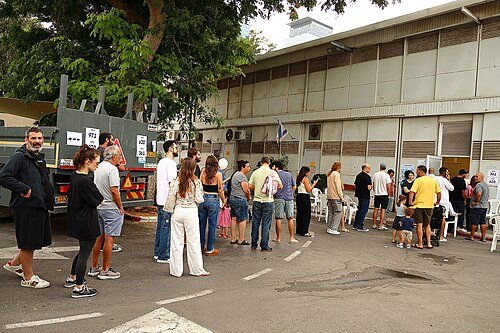
Other campaign issues included Arab turnout and access to voting, market uncertainty, and security. Adalah reported complaints of missing Arabic ballots and slow voting; police separately confirmed arrests in a localized suspected vote-buying case. Reports of a Netanyahu-Zamir clash over Iran-related action were disputed, and analysts said a caretaker government retains legal war powers while having a duty of restraint.
“There are no similar incidents of this kind across the country; this was a localised case”
Dean Livne, Central Elections Committee director general · quoted in NDTV, via Times of Israel
Ra’am’s current role has a recent precedent: it joined the Bennett-Lapid coalition in 2021, the first independent Arab party to enter an Israeli governing coalition. The Times of Israel said Netanyahu was widely reported to have courted Abbas during that government-formation effort; Netanyahu denied it, Abbas maintained that it happened, and Smotrich said he prevented an alliance.
Benjamin Netanyahu, Israel's prime minister · our summary of The Times of Israel
How coverage differed
Election results and coalition arithmetic: Reports followed changing exit polls and partial counts before the final seat distribution, then examined the difficulty of forming a majority.
Election-integrity allegations and foreign-funding inquiry: Coverage set Likud’s accusations alongside the investigation request, Qatar’s denial, Arab-party responses and election-authority statements.
Campaign, security and economic implications: Reports covered Trump’s endorsements, the dispute over Netanyahu’s security messaging and caretaker powers, and the market reaction to political uncertainty.