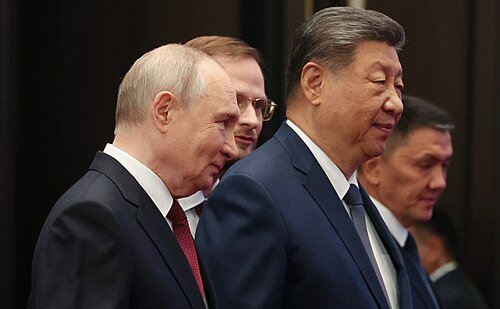
Trump, Xi and Putin weigh summit meetings and wider talks
Russian officials say China is preparing a possible Putin–Trump–Xi meeting alongside the Nov. 18–19 APEC summit in Shenzhen, but no final agreement, time or agenda has been set. Trump says he is willing to meet and names nuclear arms reduction as a main focus; Ukraine objects to discussing its future without Kyiv, while separate Ukraine–U.S.–Russia talks are also being discussed. Washington invited Putin to the December Miami G20, and Moscow has not decided whether he will attend; Trump also says he plans to meet Xi in China but is unsure whether he will meet Kim Jong-un.
Summary written by our automated pipeline from the outlets' reporting. How it works
41 outlets in 24 countries, 13 relaying others' reporting
“If [Trump] had just said, look, we have established technical working groups and we’ve agreed to a framework that has called for DeepSeek and Moonshot and Alibaba to sit down with…”
Points where outlets or parties give conflicting facts or readings. Each side is summarised by our pipeline; its sources are listed under it.
Disputed Whether Ukraine should be represented in talks about its future
Trump said he would pursue efforts to end the war whether or not someone was present.
Sources (2)
Donald Trump, U.S. president · our summary of Ukrinform, via CNBC
Donald Trump, U.S. president · our summary of Der Spiegel
Zelensky said Ukraine must be at the table when its future is discussed; Sybiha objected to a format that could sideline Kyiv, and Cassidy said Ukraine must take part in negotiations.
Sources (2)
Volodymyr Zelenskyy, Ukraine's president · our summary of Ukrainska Pravda, via European Pravda
“…it can be acceptable only when we are at the table of negotiations”
Volodymyr Zelenskyy, Ukraine's president · quoted in The Hindu
Disputed Whether Zelensky wants the war to end
Trump accused Zelensky of not wanting the war to end.
Sources (1)
Donald Trump, U.S. president · our summary of The Hindu
Zelensky said Ukraine had welcomed partner efforts to end the war and attributed its continuation to Russian strikes and Russia’s desire to prolong it.
Sources (2)
“Ukraine never wanted this war, and we have welcomed literally EVERY attempt by our partners to bring this war to a dignified end.”
Volodymyr Zelenskyy, Ukraine's president · quoted in The Hindu
“The reality is that the war continues, and it continues solely because of Russian strikes and Russia's desire to drag this war out.”
Volodymyr Zelenskyy, Ukraine's president · quoted in The Hindu
Disputed Whether the Anchorage summit made progress toward ending the war
Polyansky said the presidents reached understandings in Anchorage.
Sources (1)
“…the understandings reached by the Russian and American presidents in Anchorage a little over a year ago”
Dmitry Polyansky, Russian diplomat to the United Nations · quoted in TASS
The Kyiv Independent said the summit produced no progress toward ending the war.
Accounts conflict Whether the Kremlin made a specific proposal for an APEC-side summit
Wall Street Journal sources said the Kremlin proposed holding trilateral talks on the APEC sidelines and passed the proposal to Beijing.
Sources (2)
people familiar with the discussions · our summary of Ukrainska Pravda, via Wall Street Journal
WSJ sources · our summary of Ukrainska Pravda, via The Wall Street Journal
Peskov said the possibility had been mentioned, but no one had put forward a specific proposal or agreement about the meeting or its agenda.
Sources (2)
“…the topic of such a hypothetical meeting was indeed mentioned.”
Dmitry Peskov, Kremlin spokesperson · quoted in TASS
“No specific proposals or agreements have been discussed or voiced by anyone, neither on the meeting itself [between Putin, Xi Jinping, and Trump] nor on a potential agenda or the…”
Dmitry Peskov, Kremlin spokesperson · quoted in TASS
Disputed The main purpose of a possible Trump-Xi-Putin meeting
Wall Street Journal sources said Putin wanted to discuss ending the Ukraine war on terms favorable to Moscow.
Sources (1)
Vladimir Putin, Russia's president · our summary of The Hankyoreh, via Wall Street Journal
Trump said a meeting would focus mainly on reducing nuclear arsenals rather than settling the Ukraine conflict, with trade also possible.
Sources (2)
“We would have it to talk about nuclear weapons and denuclearisation”
Disputed What Putin’s possible G20 attendance would mean
Rubio presented the summit as an opportunity for Putin to engage with Trump and other world leaders.
Sources (2)
“We think it's an opportunity for him to engage not just with the president but with other world leaders”
Marco Rubio, U.S. secretary of state · quoted in TASS
Marco Rubio, U.S. secretary of state · our summary of Der Spiegel
A bipartisan group of senators said Putin’s participation could legitimize and normalize the Russian government and urged Trump to withdraw the invitation; a diplomatic source said Russia’s G20 presence did not legitimize its actions.
Sources (2)
bipartisan group of U.S. Senators, U.S. senators · our summary of The Kyiv Independent
“…raises serious concerns about legitimizing and normalizing a government that continues to attack Ukrainian civilian targets every day.”
bipartisan group of U.S. Senators, U.S. senators · quoted in The Kyiv Independent
Disputed The leaders’ account of U.S.-China cooperation in World War II
The leaders recalled China and the United States fighting as allies during World War II.
A Taiwanese senior official said World War II history must not be distorted and Taiwan people’s right to exist must be respected; The Hankyoreh said the leaders’ account erased the Republic of China from Taiwan’s perspective.
Pascal Confavreux, French Foreign Ministry spokesperson
“This year, the United States holds the G20 presidency, and as the host country, it is responsible for organizing the discussions and determining the list of invitees”
Machine translation: “Bilateral talks are currently under consideration, and I will refrain from saying which country we will hold talks with at this stage.”
Poland
Radosław Sikorski, Poland's foreign minister
“…the bloody Russian aggression against Ukraine must stop”
“…has a longstanding policy not to have direct, bilateral engagement with Russian ministers since the invasion of Ukraine and we are not about to change that”
“The only thing they seemed to agree about is that neither of them wants to slow down with this technology, regardless of their actual understanding of it.”
“…the wisdom of not allowing the boat to rock more than is inevitable, of managing crises step by step, issue by issue, or at least maintaining communication – because the…”
Xi and Trump agreed on a vision of a constructive China-US relationship of strategic stability intended to guide relations for the next three years and beyond.
On October 19, Trump said he would meet Xi and Putin if Xi wanted, with nuclear weapons and reducing arsenals as the main focus and trade another possible topic.
Trump says the meeting would focus mainly on reducing nuclear arsenals rather than on settling the conflict in Ukraine.
Donald Trump, U.S. president · our summary of TASS
2026-10-19
On October 19, Sybiha said a Russia-China-U.S. meeting would encourage Putin to continue the war, while a Ukraine-U.S.-Russia meeting could help end it sooner.
Ushakov says preparations for a future summit of Putin, Trump and Xi on the sidelines of APEC have already begun.
Yuri Ushakov, Assistant to Russia's president · our summary of RIA Novosti
Ushakov says Moscow, Beijing and Washington are in principle ready to hold the meeting and that preparations have already started.
Yuri Ushakov, Assistant to Russia's president · our summary of RIA NovostiAs quoted in Russian, with a machine translation
“Сейчас уже я могу точно сказать, что и в Москве, и в Пекине, и в Вашингтоне в принципе готовы к ее проведению (встречи - ред), уже к ней началась подготовка”
Machine translation: “Now I can say for certain that in principle Moscow, Beijing and Washington are all ready for it to take place (the meeting — ed.); preparations for it have already begun.”
Ushakov says Chinese representatives approached the negotiations very seriously.
Yuri Ushakov, Assistant to Russia's president · our summary of RIA Novosti
2026-10-28
On October 28, Rudenko said China was working on arrangements but no final decision existed; Peskov said all three states were potentially ready, with no final agreement or time.
Each outlet's headline, linked to its article. Non-English headlines are machine-translated. The groupings and notes on what each outlet emphasises are automated.
Our outlets in Poland, Australia and Israel didn't cover it.
Written by our automated pipeline from the statements in the coverage; each point lists the statements it rests on.
Key points
The possible APEC-side Putin–Trump–Xi meeting remains unsettled. Wall Street Journal sources said the Kremlin proposed talks on the summit’s sidelines and passed the proposal to Beijing; Peskov said the idea had been raised hypothetically but no specific proposal or agreement on the meeting or agenda had been put forward. Ushakov said China was preparing and the three capitals were ready in principle; Putin supported the possibility but said its agenda needed defining. Rudenko said the meeting was unconfirmed and its agenda, including arms control, remained under discussion, while Peskov said no final agreement or time had been set.
Sources (4)
WSJ sources · our summary of Ukrainska Pravda, via The Wall Street Journal
The Wall Street Journal · our summary of Ukrainska Pravda, via The Wall Street Journal
“…the topic of such a hypothetical meeting was indeed mentioned.”
Dmitry Peskov, Kremlin spokesperson · quoted in TASS
“No specific proposals or agreements have been discussed or voiced by anyone, neither on the meeting itself [between Putin, Xi Jinping, and Trump] nor on a potential agenda or the…”
Dmitry Peskov, Kremlin spokesperson · quoted in TASS
The proposed summit’s purpose and format carry different stakes. Wall Street Journal sources said Putin wanted to discuss ending the Ukraine war on terms favorable to Moscow, without Zelensky at the table; Trump said nuclear weapons and reducing arsenals would be the main focus, with trade also possible. Trump said he would pursue efforts to end the war whether or not someone was present. Sybiha said a Russia-China-U.S. meeting would encourage Putin to continue the war, while a Ukraine-U.S.-Russia meeting could help end it sooner; Kyiv warned of a dangerous signal and Zelensky insisted Ukraine must be present when its future is discussed. Cassidy called deciding Ukraine’s fate without it reckless and morally wrong and said Ukraine must take part; Tillis called discussing the war at such a summit absurd and said Putin was manipulating Trump.
Sources (4)
“We would have it to talk about nuclear weapons and denuclearisation”
Donald Trump, U.S. president · our summary of TASS
Donald Trump, U.S. president · our summary of Ukrinform, via CNBC
Commentators questioned the balance of power and wider consequences of a great-power meeting. Prodi called the possible Shenzhen meeting a “little Yalta,” saying it could set future rules and red lines and that Europe’s exclusion would be a mistake; he attributed Europe’s marginalization to internal fragmentation and weakness. Popova warned the leaders’ next meeting could decide the fate of Canada or Taiwan. Zelensky said he wanted to understand what would be discussed.
Sources (4)
Romano Prodi, Former Italian prime minister · our summary of TASS
“This could become a meeting where rules for the future will be set and red lines that must not be crossed will be laid down.”
Romano Prodi, Former Italian prime minister · quoted in TASS
Romano Prodi, Former Italian prime minister · our summary of TASS
Romano Prodi, Former Italian prime minister · our summary of TASS
A separate Ukraine–U.S.–Russia negotiating track is also in view. At their Oct. 21 meeting, Witkoff said he brought ideas for a possible peace deal and briefed Putin on the Oslo talks. Ushakov said Russia was ready in principle to resume trilateral talks around mid-November on postwar security; in an Oct. 25 interview he said Russia would be ready after Nov. 4, expected an initial “trial run” to yield little, and argued Europe must participate. Ushakov judged the Kyiv-European approaches Witkoff relayed to have little useful substance. Zelensky supported trilateral talks and proposed freezing the front line as a first step toward ceasefire talks; Moscow said core issues, including Ukrainian withdrawal from areas it still controls in Donetsk, must be agreed first. Witkoff called his discussion with Putin constructive while saying significant work remained.
Steve Witkoff, U.S. presidential envoy · quoted in TASS
“It's really some ideas about the different elements of some sort of a peace deal between Russia and Ukraine”
Steve Witkoff, U.S. presidential envoy · quoted in TASS
Yuri Ushakov, Assistant to Russia's president · our summary of RIA Novosti
As quoted in Russian, with a machine translation
“Естественно, Стив Уиткофф информировал Владимира Путина о сути состоявшихся в Осло переговоров”
Machine translation: “Naturally, Steve Witkoff informed Vladimir Putin about the substance of the talks held in Oslo”
Washington invited Putin to the Dec. 14–15 G20 in Miami. Rubio described the invitation as an opportunity for engagement and said the United States hoped Putin would accept; Peskov said Russia appreciated it, would consider all circumstances and had not decided whether Putin would attend. Ushakov said the decision would depend on the November APEC summit. Trump said he would be glad to see Putin but did not know if he would attend. Zelensky said the G20 could host substantive Ukraine–U.S.–Russia talks and that Ukraine would attend at the highest level if invited, while saying Kyiv had received no signal of an invitation. The Atlantic, citing anonymous sources, reported that Trump wants Russia and Ukraine to sign a peace agreement there and would consider pressuring Ukraine into one. Senators urged Trump to withdraw Putin’s invitation, saying his participation could legitimize and normalize the Russian government; a diplomatic source said Russia’s G20 presence did not legitimize its actions. Brazil reported that Lula intends to attend on Dec. 14.
“We think it's an opportunity for him to engage not just with the president but with other world leaders”
Marco Rubio, U.S. secretary of state · quoted in TASS
Marco Rubio, U.S. secretary of state · our summary of Der Spiegel
Marco Rubio, U.S. secretary of state · our summary of Der Spiegel
Trump and Xi have said they will meet again in China in November and at the Miami G20 in December; Xi invited Trump and his wife to the Shenzhen APEC summit. Trump said he did not know whether he would meet Kim Jong-un during his China trip or whether anyone had requested a meeting, though he described their relationship positively. The separate APEC CEO Summit is scheduled for Nov. 17–18, and business representatives called for easier trade, lower cross-border costs and deeper regional cooperation.
Sources (4)
Donald Trump, U.S. president · our summary of Clarín
As quoted in Spanish, with a machine translation
“Nos volveremos a reunir en noviembre, en China, y luego en la cumbre del G20 en diciembre, en Miami, Florida”
Machine translation: “"We will meet again in November, in China, and then at the G20 summit in December, in Miami, Florida"”
The May and September Trump-Xi summits produced stated frameworks for strategic stability, trade mechanisms, a trade truce and AI dialogue. China described the September summit as yielding eight outcomes; the White House said the leaders agreed to an AI incident-communications channel and opposed tolls on international waterways. Xi urged the United States and Iran to negotiate and return to the Islamabad memorandum. Trump called the September talks a major success, while BBC News and analysts emphasized limited confirmed gains and identified the trade-truce extension as the main concrete result. China’s summit statement did not mention rare earths or Russia- and North Korea-related discussions covered in the White House account. The summits also touched on Taiwan and Japan: Xi urged Washington to oppose Taiwan independence, Trump said he made no promises on Taiwan, and Xi said Beijing’s dispute with Tokyo should be treated separately from U.S.-China relations. Xi advocated human control of AI while Trump said he wanted to leave AI as it was; neither leader announced barriers to AI research, and Daniel Kritenbrink predicted the incident hotline might not work properly.
The Atlanta G20 foreign ministers’ meeting on Oct. 30–31 was chaired by Rubio and intended to prepare for the Miami leaders’ summit. Washington emphasized economic security, energy and supply chains, and keeping sea lanes open; Russia said Lavrov would argue against sanctions and promote Moscow’s positions on multipolarity and security. Russia said it faced restrictions on full participation. European officials criticized Moscow over the war and pressed for a Black Sea ceasefire; an unnamed diplomat objected to Russia returning as if nothing had happened. South Korea’s Cho Hyun and India’s S. Jaishankar were scheduled to attend.
Other accounts and analysts assess the stakes of diplomacy differently. Kovrig warned that potential U.S.-China deals could leave allies such as Canada exposed. Gray rejected the view that a delayed Taiwan arms package showed U.S. passivity and said the sale could be split or spread over time. At the 2025 Anchorage summit, Putin said Russia had agreed to U.S. proposals despite difficult decisions, and Polyansky said the presidents reached understandings; The Kyiv Independent said the summit produced no progress toward ending the war. Bloomberg sources identified the meeting as a trigger for increased Russian war spending later in 2025. Witkoff called Putin a humanitarian, and former U.S. ambassador William Taylor called that description embarrassing.
Sources (4)
“So there's this inherent tension there where the U.S. wants allies like Canada to align with it on tough policies on China, but then Trump goes and potentially makes deals with…”
Michael Kovrig, International Crisis Group analyst · quoted in CBC News
Vladimir Putin, Russia's president · our summary of Ukrainska Pravda, via TASS and RIA Novosti
How coverage differed
Wall Street Journal source-based reporting and relays: These accounts describe a Kremlin proposal for an APEC-side meeting about Ukraine and possible exclusion of Ukraine; several reports relay the same Wall Street Journal sourcing.
Russian official and state-linked reporting: Coverage foregrounds Russian officials’ accounts of the possible summit’s status and Chinese preparations, as well as the separate Russia-U.S.-Ukraine negotiating track.
Chinese official sources: Official statements welcome Putin’s APEC attendance, offer no information on the trilateral summit and describe outcomes from the Trump-Xi summits.
Ukrainian outlets and officials: Coverage emphasizes Kyiv’s demand to participate in discussions about Ukraine and its objections to a meeting that could sideline it.
G20 ministerial and summit coverage: U.S. statements emphasize economic and security cooperation at the Atlanta ministerial and engagement at the leaders’ summit; Russian statements stress participation, Lavrov’s planned message and the unresolved decision about Putin’s attendance.
Business and summit coverage: Xinhua highlights the APEC CEO Summit’s organization, business cooperation and regional economic goals; other international reports emphasize Xi’s invitation and Trump’s planned China visit.