Zelensky reports partial Patriot approval as allies expand Ukraine support
European allies have expanded funding and supply routes for Ukraine: Zelensky sought at least €70 billion in extra EU support for 2027, Britain announced £10 billion in support, and the Netherlands announced military and non-military aid. Ukraine is entering a partnership with NATO’s procurement agency, while Zelensky and Ukrainian officials describe Patriot approval delays as political pressure; Rubio cited competing demand and denied deliberate withholding, and U.S. officials said transfers remained unapproved but had not been formally rejected.
Summary written by our automated pipeline from the outlets' reporting. How it works
34 outlets in 20 countries, 8 relaying others' reporting
U.S. officials said Hegseth had not formally rejected the transfers but had not completed approval steps; a U.S. official disputed Ukraine’s allegation.
Sources (1)
U.S. officials, U.S. government officials · our summary of Ukrinform, via The Washington Post
Disputed Whether Western support helps Ukraine resist Russia or prolongs the war
Zelensky said the requested funding would help Ukraine hold Russia back.
Sources (1)
Volodymyr Zelenskyy, Ukraine's president · our summary of Ukrainska Pravda, via European Pravda
Russia says Western funding and weapons prolong the conflict and hinder diplomacy.
“There are so many figures being bandied about that we now need to put them into context, explain them and make it clear where this shortfall is coming from”
Diplomats said Denmark, Italy, and Poland sought stronger language on immigration, backed by more than ten countries, but the proposal failed after France, Spain, and Luxembourg opposed it.
Zuleeg argued that Europe's investment needs cannot be financed through national budgets alone and called for innovative financing, including new common borrowing.
Von der Leyen acknowledged that Ukraine's financial needs will keep growing while the conflict continues.
Ursula von der Leyen, European Commission president · our summary of RIA Novosti
Von der Leyen called on other international partners to increase aid to Kyiv.
Ursula von der Leyen, European Commission president · our summary of RIA Novosti
2026-10-18
On 18 October, Zelensky told Bloomberg he believed Washington had taken steps to pressure Ukraine toward capitulation and was delaying Patriot missiles.
Deliveries of interceptor missiles to Ukraine may be delayed because many US allies are seeking the same weapons.
Marco Rubio, U.S. secretary of state · our summary of Ukrainska Pravda, via European Pravda
“…there has not been some deliberate political directive to go out and harm Ukraine”
Marco Rubio, U.S. secretary of state · quoted in Ukrainska Pravda, via European Pravda
2026-10-22
Reported on Oct. 22, the Financial Times said Ukraine was entering a partnership with the NSPA to procure weapons, ammunition and other military equipment.
On Oct. 26, Zelensky said Ukraine had waited nearly a month for Hegseth to approve Patriot and NASAMS missiles and instructed his team to raise the issue again.
“I instructed our team to raise this with the American side once again.”
Volodymyr Zelenskyy, Ukraine's president · quoted in Ukrainska Pravda
2026-10-27
At a closed-door briefing on Oct. 27, Zelensky said Ukraine received an average of 12 Patriot interceptors per month in 2026 and needed about 150 a month to intercept Russian ballistic missiles.
If European leaders fail to agree at the November 26-27 extraordinary meeting, they will try again at the December 17-18 meeting.
Antonio Costa, President of the European Council · our summary of TASS, via Rapporteur
Coverage
Each outlet's headline, linked to its article. Non-English headlines are machine-translated. The groupings and notes on what each outlet emphasises are automated.
None of our outlets is based in Slovakia, Hungary, Austria, Bulgaria, Czechia, Estonia, Belgium or Italy. Our outlets in Netherlands didn't cover it.
Written by our automated pipeline from the statements in the coverage; each point lists the statements it rests on.
Key points
At the October EU summit, Zelensky sought at least €70 billion in additional 2027 funding for defence, weapons and resilience, saying Ukraine’s war costs would reach €155 billion. The European Commission acknowledged a €70 billion shortfall; EU sources said it came on top of money under the existing €90 billion loan. The European Council tasked the Commission with proposals. RIA Novosti, relaying the Financial Times, said proposals were expected by the end of November; a senior EU official said the work was at an early stage, had no set preparation date, and did not necessarily need approval by year-end. That official said there was no answer yet on possible use of frozen Russian assets.
Sources (4)
“We need at least 70 billion euros more from you -- for defense, for weapons, and for our resilience”
Volodymyr Zelensky, Ukraine's president · quoted in Xinhua
Volodymyr Zelensky, Ukraine's president · our summary of Xinhua
European Pravda's sources in the EU, EU sources · our summary of Ukrainska Pravda
Responses to the request included Macron’s view that it was too early to put a figure on it, Stocker’s call for context on the figures and shortfall, and von der Leyen’s warning that Ukraine’s needs would grow and her appeal for other partners to increase aid. Vannacci called for stopping transfers and redirecting the money to European citizens. Costa urged continued support and pressure on Russia; a European diplomat said leaders promised funding under the existing loan, while TASS reported no new financial package or arms shipments at the summit. EU leaders did not agree on the main parameters of the 2028–2034 budget.
Sources (4)
Emmanuel Macron, France's president · our summary of CNews
As quoted in French, with a machine translation
“…c'est trop tôt pour articuler un chiffre”
Machine translation: “…it is too early to put a figure on it”
“There are so many figures being bandied about that we now need to put them into context, explain them and make it clear where this shortfall is coming from”
Christian Stocker, Austria's chancellor · quoted in CBC News
Ursula von der Leyen, European Commission president · our summary of RIA Novosti
Ursula von der Leyen, European Commission president · our summary of RIA Novosti
Patriot supply remains a key concern. Zelensky said Ukraine averaged 12 U.S. missiles a month in 2026, received about 150 annually and needed to intercept around 150 Russian ballistic missiles each month. He said Hegseth had approved a U.S. package of 12 missiles but that 23 sourced elsewhere still needed U.S. approval; he also said Ukraine had used 35 missiles that month. Zelensky separately said Ukraine had received only 24 U.S. interceptors over three months and needed an average of 350 monthly. On Oct. 26, he said Ukraine had been waiting nearly a month for approval of missiles for Patriot and NASAMS systems and instructed his team to raise the issue again.
Sources (4)
“In 2026, we're receiving an average of 12 missiles a month.”
Volodymyr Zelenskyy, Ukraine's president · quoted in Ukrainska Pravda, via Ukrinform
Ukrainian officials described the pending approvals as political pressure and said delays could put civilian lives at risk; one official called the hold-up a political refusal to sign. U.S. officials cited by The Washington Post said Hegseth had not formally rejected allied transfers but had not completed the necessary approval steps, while continuing to approve some other assistance. Rubio said high demand and competing obligations could delay deliveries, denied deliberate withholding or a political directive to harm Ukraine, and said U.S. weapons supplies under PURL and intelligence sharing were unchanged. He also said Washington continued providing the same airstrike warnings. NATO officials said PURL support continued to flow, and a U.S. official disputed Ukraine’s allegation of political withholding.
U.S. officials, U.S. government officials · our summary of Ukrinform, via The Washington Post
U.S. officials, U.S. government officials · our summary of Ukrinform, via The Washington Post
Patriot stock reports differed: CNN, citing unnamed sources, said the stockpile had run out on Oct. 15, while a Ukrainian official cited by The Washington Post said only a handful remained by mid-October. Zelensky also accused Washington of taking steps to pressure Ukraine toward capitulation; the U.S. government denied intending to force Ukraine to capitulate. The Kyiv Independent said the U.S. government had not publicly confirmed Zelensky’s latest figures or explained the reported delays.
“I believe steps have been taken to convince Ukraine to capitulate”
Volodymyr Zelensky, Ukraine's president · quoted in Ukrinform, via Bloomberg
Volodymyr Zelensky, Ukraine's president · our summary of teleSUR English, via EFE
Ukraine is entering a partnership with the NATO Support and Procurement Agency, although Yonhap described the signing as still forthcoming. The arrangement would let Ukraine buy weapons, ammunition and equipment through NATO’s centralized procurement system, separate from PURL. NSPA official Jacqueline Borsboom described access to agency expertise, services and its industrial base; Ukraine’s NATO envoy Aliona Hetmanchuk hoped the partnership would widen access to NATO’s defence industry and agency-managed contracts. Ukrainian reporting said the channel could speed deliveries, reduce costs and reduce reliance on bilateral negotiations; Yonhap gave a possible purchase of 30,000 uniforms as an example. Reports said an NSPA industry event in Kyiv drew about 150 Ukrainian companies.
Other supply and delivery developments include EU Council decisions reimbursing member states €4.7 billion for military aid already delivered and providing €230 million for EUMAM Ukraine; Poland’s selection to host a Patriot-missile maintenance centre; Denmark’s delivery of more than 50,000 rounds for F-16 cannons; and Germany’s expected initial purchase of Ukrainian Bars missiles for testing. E5 defence ministers reaffirmed support for Ukraine and said Europe should take greater responsibility for its security within NATO while keeping the United States involved. Coalition of the Willing exercises in Poland were planned to rehearse troop movements and logistics for a possible post-ceasefire deployment.
The Netherlands announced €500 million in winter military aid, including air-defence equipment and drones, and a separate €1.2 billion non-military package for 2027–2029. The latter combines €878 million previously pledged with a further €327 million announced alongside the budget; it includes €40 million for the Ukraine Energy Support Fund and €55 million for energy equipment. Britain announced £10 billion in additional support: Zelensky said this includes £7 billion in economic support over three years and £3 billion in export support, mainly for weapons, and is additional to annual assistance. Healey described loans, Export Finance guarantees and £500 million in urgent winter military funding; the British government put total commitments at £35 billion, including £16 billion in military support.
Sources (4)
Rob Jetten, Dutch government official · our summary of RIA Novosti
Rob Jetten, Dutch government official · our summary of RIA Novosti
As quoted in Russian, with a machine translation
“В него входят, среди прочего, средства противовоздушной обороны и дроны”
Machine translation: “It includes, among other things, air defense systems and drones.”
Zelensky proposed U.S.-Russia-Ukraine talks by Nov. 10, preferably Nov. 6–10, and said Ukraine was waiting for U.S. answers after the election. He said Ukraine needed representation in negotiations on all issues and Europe would be involved in future security guarantees. Dutch trade minister Sjoerd Sjoerdsma said Ukraine must be at the table in peace discussions, the EU should play a larger political role, and other European countries should increase support. Zelensky also offered a 30-day pause in Ukrainian strikes on Russian refineries in exchange for U.S. help protecting Ukraine’s skies with Patriot interceptors, saying Ukraine had heard no willingness to support that option. The Kremlin continues to demand that Kyiv cede Donbas.
Sources (4)
Volodymyr Zelensky, Ukraine's president · our summary of Yonhap News Agency, via Kyiv Independent
As quoted in Korean, with a machine translation
“내달 말까지, 가능하면 11월 6일에서 10일 사이에 이 회담이 열려야 한다”
Machine translation: “This meeting should take place by the end of next month, if possible between November 6 and 10.”
Volodymyr Zelensky, Ukraine's president · our summary of Yonhap News Agency
As quoted in Korean, with a machine translation
“우리는 미국 측을 기다리고 있으며 선거 이후에 모든 답변을 내놓을 것으로 생각한다”
Machine translation: “We are waiting for the American side and think they will provide all the answers after the elections.”
“…we need to talk at the leaders' level, with Ukraine represented”
Volodymyr Zelensky, Ukraine's president · quoted in Ukrinform
Volodymyr Zelenskyy, Ukraine's president · our summary of Ukrainska Pravda, via European Pravda
Ukraine’s draft 2027 budget projected $161.2 billion in total spending, including $108.3 billion for the military, $50.9 billion for weapons and equipment, and $39.7 billion for military salaries. The Finance Ministry projected $125 billion in state revenue, including $55 billion in grants from Western programmes; TASS calculated total revenue including bond sales, privatization and grants at $82.9 billion and put the military-spending shortfall at $25.4 billion. Ukraine’s government estimated external financing needs for budget execution and defence at $78.1 billion, an estimate broadly shared by the cited European institutions.
The UK Budget debate also covered defence spending. Healey said meeting the 3% target would require scrutiny of public spending and proposed treaty negotiations with Finland, Poland and the Netherlands on sharing resources. Badenoch said he had offered only a plan to make a plan and was making the country less safe, while Rutte said the UK was on a credible path toward NATO’s commitment. IFS director Helen Millier questioned how much investment in defence companies would improve UK capabilities. Farage said higher gambling-shop duty would hurt horse racing and drive gambling offshore and through crypto; Resolution Foundation chief executive Ruth Curtice called the Budget scattergun and said it did little to address Britain’s challenges.
Sources (4)
John Healey, UK government minister · our summary of BBC News
John Healey, UK government minister · our summary of BBC News
Kemi Badenoch, UK Conservative Party leader · our summary of BBC News
“He is the man who is making our country less safe”
Kemi Badenoch, UK Conservative Party leader · quoted in BBC News
How coverage differed
Ukrainian outlets: Coverage foregrounded Ukraine’s funding and winter air-defence needs, pending missile approvals, procurement routes, and Dutch and British support.
Russian state outlets: Coverage included Russia’s objections to Western weapons and accounts of Patriot supply and EU funding.
Reports relaying the Financial Times: These accounts covered the EU funding timetable, Ukraine’s NSPA partnership and Germany’s expected purchase of Ukrainian Bars missiles; relays are not independent confirmation.
European and allied coverage: These reports focused on defence coordination, reimbursement for delivered aid, Patriot maintenance, ammunition deliveries and allied procurement.
UK outlets: Coverage included the Ukraine support announcement and domestic debate over defence spending and other Budget measures.
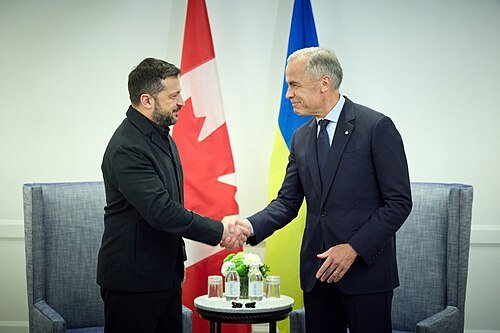
Ukrainian President Volodymyr Zelenskyy meets Canadian Prime Minister Mark Carney in Canada on September 10, 2026. The meeting covered Canadian support for Ukraine, including Patriot missiles.